
Omnipedia #30: Radical play, from E. Musk to black-power dolls; Open AI preps for Star Trek economics; SF is your biggest tool, & more
Including: Posthuman Pat is alive! While the Scotgeist shimmers, with Momus and Angus Deaton

Tilting heavily into the future on this week’s Omnipedia—you’d think there was a horrible present we were scrambling away from… If you enjoy this, please consider financially supporting. All the buttons below, and at the end:
I’M living slightly in the Be-Careful-What-You-Wish-For Cafe at the moment. That’s what it feels to be a life-long play advocate, while reading all these Elon Musk stories from the new Walter Isaacson biography, showing him to be an ontological gamer - that is, it’s how he deals with and understands reality.
Issacson distils the seven life lessons that Musk has learned from playing The Battle of Polytopia, a crudely pixellated civilisation-and-tech building game.
Play life like a game: “I have this feeling,” says one of his confreres, “that as a kid you were playing one of these strategy games and your mom unplugged it, and you just didn’t notice, and you kept playing life as if it were that game.””
The rest: Empathy is not an asset · Do not fear losing · Be proactive · Optimise every turn · Double down · Pick your battles · Unplug at times
From The Atlantic: “Elon Musk, in his words, is ‘wired for war’…Civilization, Warcraft: Orcs & Humans, The Battle of Polytopia, Elden Ring—Musk has spent much of his life in fantasy worlds… The video-game detail is telling. Musk doesn’t seem to inhabit our reality, exactly, even as he profoundly shapes it.”
All of this is an example of what I call elite SUPERPLAY, in the book taking shape elsewhere on this E2 site - where the playful/gameful imaginings of moguls and oligarchs get ever closer to realisation, with the citizens as end-users of, or spectators upon, the public prototypes of hyper-agents. My book seeks to identify how such creative, future-occupying agency can happen for the people, and from below - using what tools, institutions and cultural forms. Not easy.
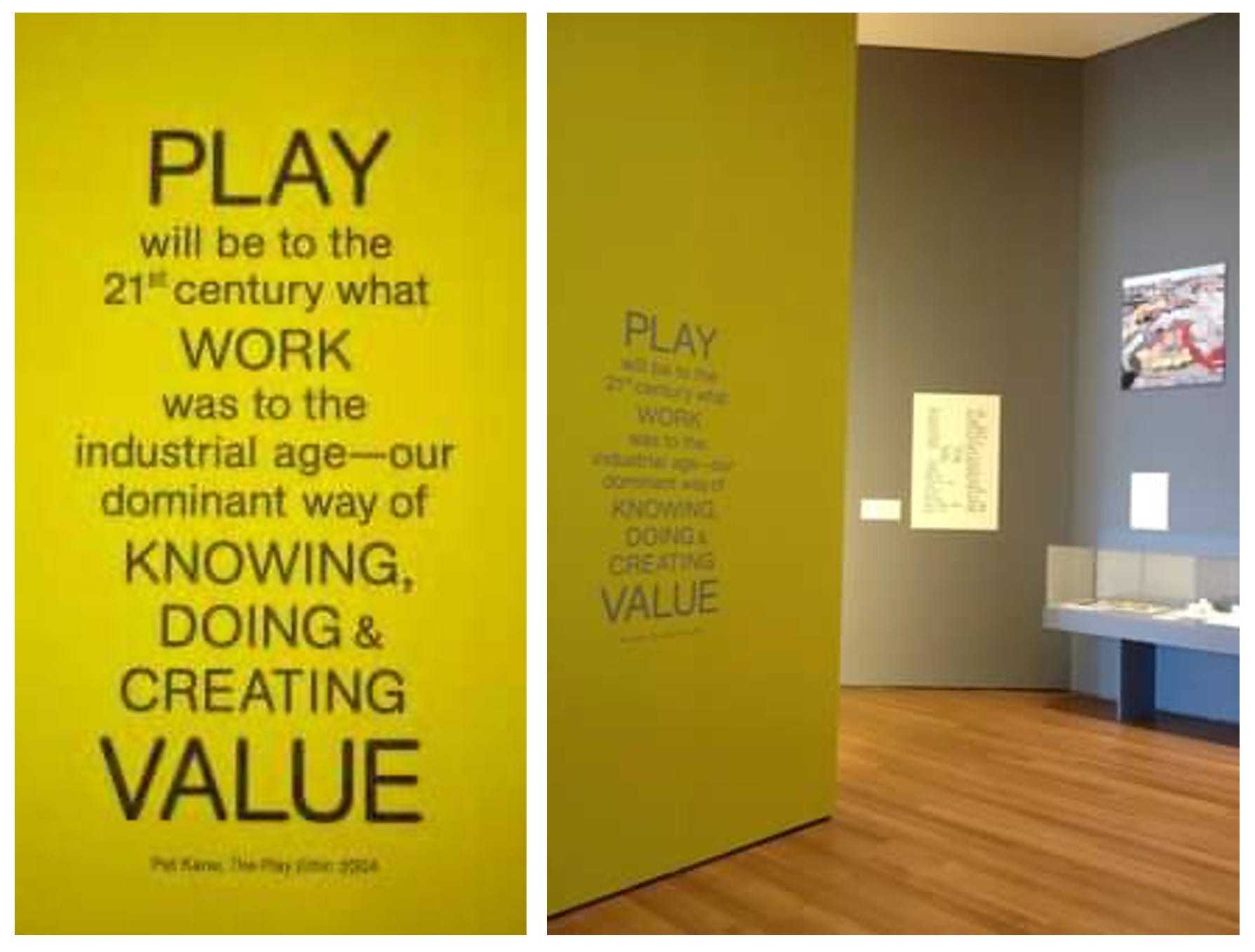
Meantime, Musk’s ludophilia keeps extending everywhere: now setting up X/Twitter as a streaming game space, playing Diabolo 4. He’d bring out the puritan in you… though I did predict his mode of being in 2004 (from MOMA, 2012)
BUT maybe to show how play culture is open to power-plays from all angles… Here’s an excerpt from an interview with Rob Goldberg, the author of Radical Play: Revolutionising Children’s Toys in 60s and 70s America. Superbly timed for the Barbie mania, Goldberg reveals a history where hard-nosed toy businesses responded to the times:
….One of the most remarkable things that activists did during this era was to take radical toy production into their own hands, and in the most significant cases, they did so in collaboration with toymakers.
In 1968, leaders of the Black Power movement in Los Angeles, with the technical and financial support of Mattel, started a toy company to design and manufacture non-stereotyped Black dolls that celebrated Black identity and culture as never before.
That company, Shindana Toys, grew to be the largest manufacturer specializing in Black dolls, selling its products at Sears, Macy’s, and other chains. In the early 1970s, a feminist educator from the Women’s Action Alliance convinced the Milton Bradley Company to produce an unprecedented series of non-sexist toys based on her handmade toy prototypes.
The toys were sold to nursery schools nationwide throughout the 1970s. In this sense, activists protested and partnered with the toy industry in their efforts to create toys that reflected and advanced their visions of a more inclusive America.
Were there any unexpected or particularly surprising influences on toy culture you discovered while writing this book?
I didn’t expect the people involved in toy activism to have such deep connections to the other social movements of the time. Lou Smith, cofounder of Shindana Toys and its first president, was a leader in the Congress of Racial Equality in Philadelphia, Harlem, and Los Angeles. In 1964, he participated in the Mississippi Freedom Summer campaign.
Letty Cottin Pogrebin, who helped popularize the feminist critique of sexist toys, including the Barbie doll, was intimately involved in the women’s rights organizations of the era.
And Victoria Reiss, the chief organizer of anti-war toy activism in New York, the epicenter of the industry, was also active in the anti-nuclear and anti-Vietnam War movements. These people turned to toy reform not as a break from their more traditional political activism but as an extension of it.
I also was amazed at how many toy companies engaged explicitly with the protest movements of the time, in some cases outwardly supporting them. Lionel and LEGO spoke out against war and gun violence [see ‘USA: 1962’ section here.]
Ideal Toys described its Derry Daring doll, which rode a stunt cycle, as a direct response to sexism in the toy culture. Remco Industries appealed to the ideals of the civil rights movement to promote its ethnically correct Black dolls in the late 1960s.
Read the book’s introduction for free here {PDF]. And from The New Yorker, specifying the movie version as “Malibu Barbie 1971”, a contextualisation from Rob’s research.
🚀🚀🚀 USEFUL passage of links from an Eliot Peper blog on the utility of speculative fiction:
What if genetic engineers resurrected dinosaurs? Read (or watch) Jurassic Park. What if we reinvented democracy for the internet age? Read Infomocracy. What if a lone astronaut got stranded on Mars? Read (or watch) The Martian. What if a single human being sought to reclaim utopia from dystopia? Read Parable of the Sower. What if we establish a new institution empowered to represent the interests of future generations? Read The Ministry for the Future. What if our digital lives subsumed our physical lives? Read Neuromancer. What if a billionaire hijacked the climate with geoengineering? Read Veil. What if we used our political, cultural, and technological powers to build a kinder world order? Read Too Like the Lightning.
…The rocket scientists who took humanity to the moon found their vocations thanks to the stories of Jules Verne and HG Wells. WarGames prompted Congress to pass the first anti-hacking law. The founders of Oculus handed out copies of Ready Player One to early employees, and books from authors like Ted Chiang, Neal Stephenson, Cixin Liu, and Isaac Asimov fill Silicon Valley bookshelves. N.K. Jemisin’s world-building informs how leading journalists like Ezra Klein make sense of the real world. Ursula K. Le Guin’s books influenced a generation of musicians. Edward Snowden carried a Cory Doctorow novel with him when he fled the United States to blow the whistle on the NSA. sods
And noted in passing, found on X: Eliezer “AI Will Kill Us We’re All Going To Die” Yudkowsky’s SF lit inspirations.
Took an old pop publicity photo of me, put it through an AI animator, and we’re now training him to be projected upon a fit young projection-mapped dancer, around 2030. (Unfortunately Posthuman Pat is a bit neurotic boy outsider at the moment - and seems to be shilling for some company - but we’ll whip those surly parameters into shape.)
From Wired magazine’s set of Open AI interviews, this intriguing bit of contract law with their financial investors:
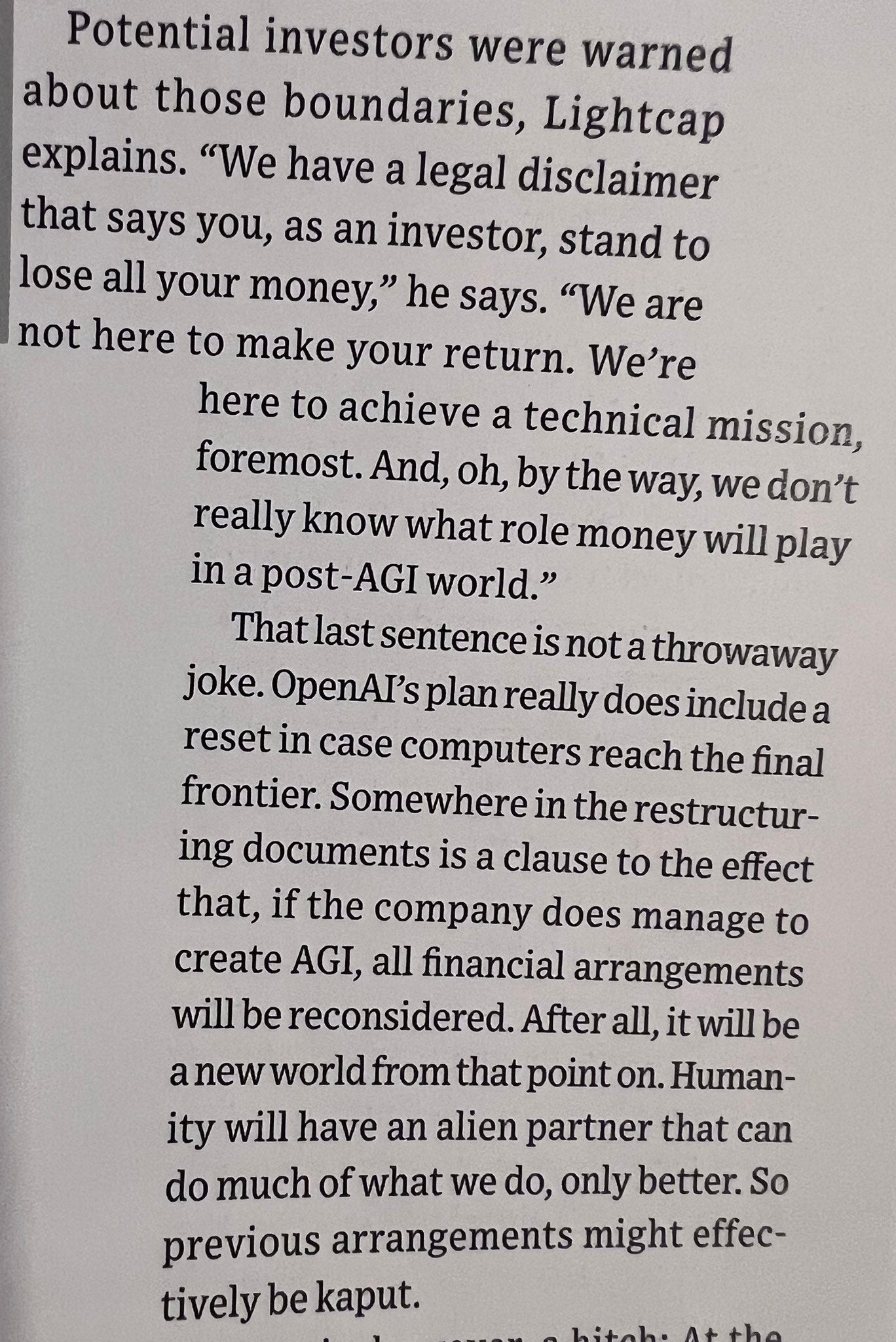
Which provides the excuse to present this notorious Star Trek precedent for Fully Automated Luxury Whateverism. “We have grown out of our infancy, sir!”
There was a kerfuffle raised in consciousness studies circles the other week, when one major school of it - Integrated Information Theory - was denounced as pseudo-science, by means of a letter signed by many neurosciensts, cog-scientists and philosophers. The accusation seems to be that it veers close to panpsychism - that everything in the universe has a degree of consciousness.
Anil Seth has written a judicious framing of the debate in Nautilus, and by means of that informing me for the first time about the subtleties of IIT. This paragraph makes quite the distinctions:
In IIT, the amount of consciousness a system has is tracked by a mathematical quantity called Phi, and, according to the theory, wherever there is non-zero Phi, there will be consciousness, at least to some degree.
This implies a restricted form of panpsychism, since instances of non-zero Phi can be found beyond brains, and even in non-biological systems. Some very simple systems can be conscious according to IIT, such as grids of inactive electronic circuitry in a computing device—though the kind of consciousness involved may be very minimal.
But many other things—whether simple or complex—will lack consciousness entirely, because they don’t integrate information in the right way. For example, according to IIT, things like tables and chairs wouldn’t be conscious, and neither would artificial intelligence systems in which signals can only flow in one direction.
I am not totally baffled by this, as one of my trackings is the joint work of Karl Friston and Mark Solms on consciousness (more by David Wood here). They use the mathematical concept of a Markov Blanket - which helps to define the interior and exterior of any organism. By this , they theorise about how consciousness (understood as an “inside” perceiving an “outside”) might be generated by any sufficiently “feeling” entity - whether it was biological, mechanical or virtual.
And literally, as I finish this entry, an AI luminary (Max Tegmark) drops a paper claiming to prove that LLMs (the ChatGPTs of everyday fame) learn “not merely superficial statistics, but literal world models”, based on an understanding of space and time.
Why do I remain interested in this? Because, as Harari usefully alarums below, these synth-sentients will be the real “alien encounters” of our century. And we have to prepare ourselves.
SCOTGEIST
👹THE polymorphous capacities of Momus fully extended in his new album, ‘Krambambuli’. Videos and lyrics here.
💸🤑Angus Deaton on economics: “the profession has become intoxicated with markets and money, losing sight of its primary mission as set out in its earliest days by Adam Smith, John Locke and others who came to economics via philosophy and other fields, rather than commerce. ‘The discipline has become unmoored from its proper basis, which is the study of human welfare’” [Bloomberg]
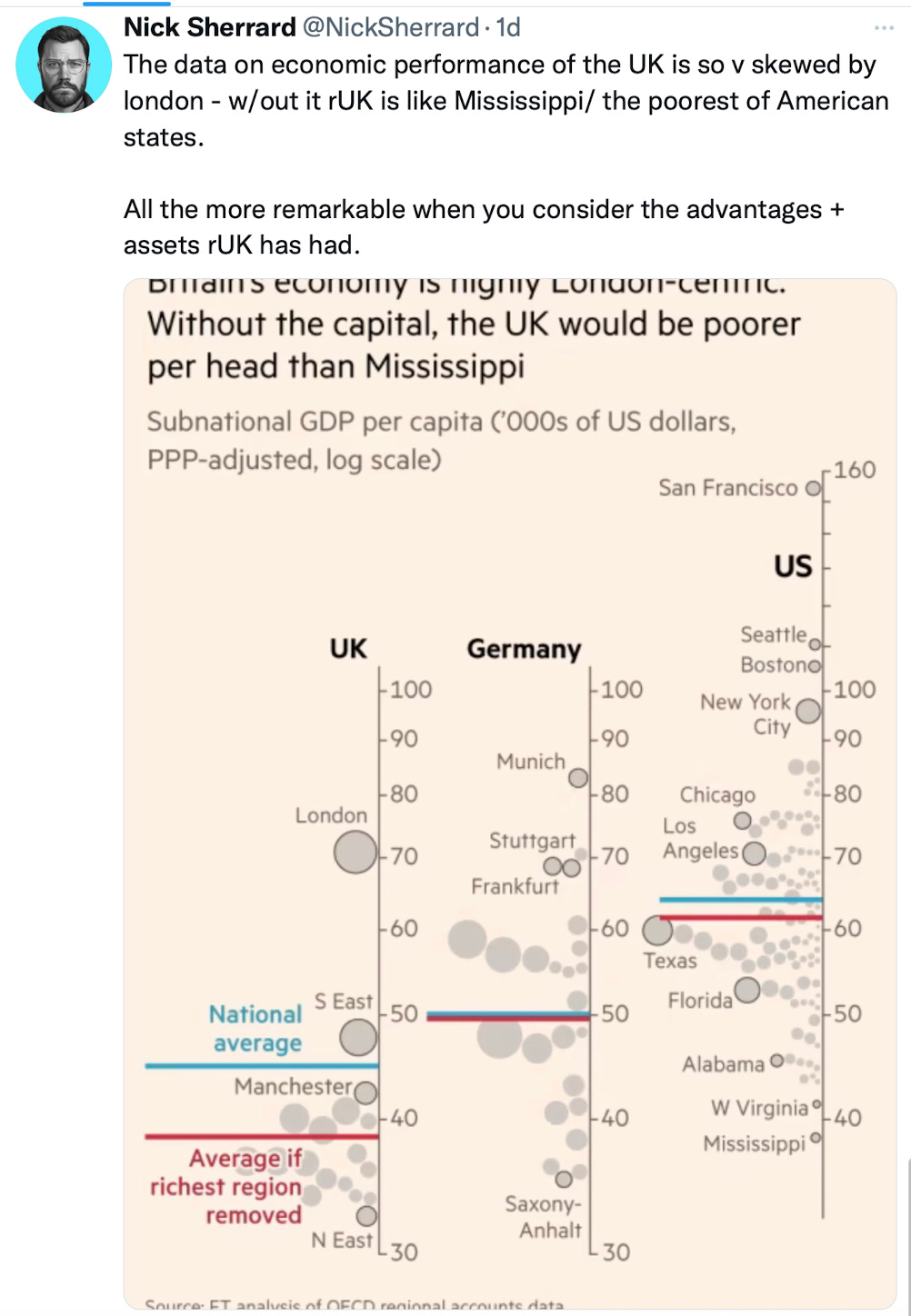
Nota bene from Nick Sherrard:
🏴A final shout-out to Bella Caledonia, responding to the Scottish predicament with anger, eclecticism, artistry, autonomism and intellect. Essential resource for sanity in this wee country
One last push, and we’ll be there (or thereabouts)... If this has been edifying/useful/entertaining, please consider financially supporting us, by means of the button below. Best, ad astra, PK x
Your AI is a bit stllted. And Whits way that weird voice. Loved your article