
Part 2.0 of SUPERPLAY: Fields of Superplay. 2.3: The StudioLab
Manifesting imagination directly. But info-play is more acceptable than bio-play

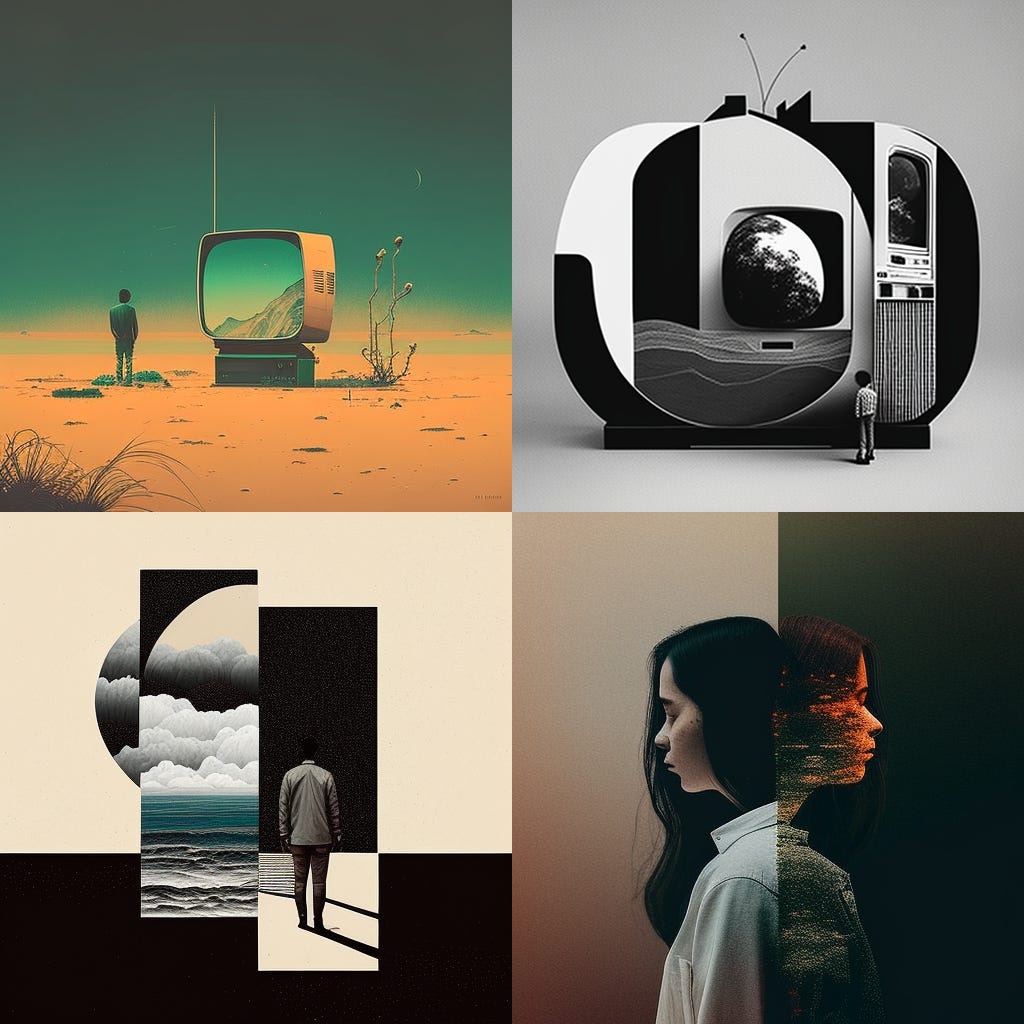
Welcome to the next installment of my beta-book follow-up to 2004’s The Play Ethic, provisionally entitled SUPERPLAY: This Is Not A Rehearsal. Here’s the archive of previous parts/chapters, and hotlinks to the early book plan are below.
I hope you can support SUPERPLAY, with the monthly, yearly or Founding Member options.
In advance, thank you!—PK
BOOK PLAN:
PART ONE: THE PLAY WE WERE
PART TWO: FIELDS OF SUPERPLAY
2.1 The Imaginarium
2.2 The Antagon
2.3 The StudioLab
THE core thesis of SUPERPLAY is that play’s two prime evolutionary functions - that is, as a rehearsal space to prepare us for complex living with others, and as the generator of new ideas to break out of niches - are mutating.
For early 21st century humans, as they grapple with transformative technology, play’s rehearsal for reality can easily become a reality itself. The amount of days humans spend in virtual worlds, across a variety of spaces–computer games, film and tv franchises, alternative currency regimes, immersive VR headsets–becomes a commitment to exist there.
Love, money, power, solidarity, freedom (and exploitation) are as directly to be found in these digitally-mediated zones, as they might be in the rooms, squares and streets of the built world. This is “reality+”, as philosopher David Chalmers recently claimed. Chalmers anticipates that these virtual worlds will become ever more compelling and engaging to us - that virtual reality is genuine reality.
Yet this future trend will take these games and frames away from the functions they’ve served in human evolution. If our virtual worlds become so immediately consequential, where and when do we “play out”—or as Brian Sutton-Smith would put it, “adaptively potentiate”—our possibilities for living? One might anticipate adding to our existing long list of mental health troubles a “play-as-rehearsal deficit”. This drives an anxiety that the ability to test and develop our roles and identities is being lost to us. Particularly as business bids to administer this virtuality as a regime of productivity and consumption, known recently as the “metaverse”.
So there’s a psychological challenge, in the diminution of play as rehearsal for reality. But in relation to the ideas-generating function of play, there’s also an ontological challenge opened up, especially by transformative tech. What happens when new ideas, fuelled by exponentially-advancing computation, can be made ever more quickly and viably real? When the prototype easily escapes from its sandbox, and becomes effective (and often disruptive) in the world? When the toy can readily be used as a tool or device for radical change?
In the current moment of technoculture in the developed world, we are gripped by these issues. The frenzy is around artificial intelligence, and its recently forged capacities to generate and simulate human discourse from text prompts, in language, imagery (static or moving), computer code and even primary science. Chatbots function like calm and skilled interlocutors, helping us with our thorniest conceptual and ethical conundrums. The complex folding of proteins is made much more predictable through computation, simulating their intricately subtle actions, unleashing a wave of new medical cures.
These are tools of SUPERPLAY, to the extent that prose prompts are converted into different semiotic and symbolic forms - not just more language, but other formal systems (like computer code or chemical combinations), as well as visual imagery. Specifically with text and image, these are not plans for, or sketches of forms - they are often the finished forms themselves, effective and complete in their functioning. Nothing would seem to demonstrate more what SP points towards - the narrowing gap between imagination and its realisation.
The organisations that operate in this space—that is, of quickly-realised imagination—come under the category of what I’m calling a studiolab. The lab-part should be obvious - a delimited area where the tools and processes of realisation are carefully and methodically developed.
The studio-part is the space in which the organisation brings its transformative tech not just to the public’s attention, but also invites their participation and even co-creation. The latter function is explicit in current AI; our intense usage of chatbots refines and improves their operations.
But what fascinates me about AI, as an enablement of SUPERPLAY, is that the very public operation of these studiolabs has produced a social panic.
Moratoriums on development have been called for by authoritative groups of scientists and technologists. Time magazine published an essay which held out the option of bombing server farms, if an AI emerged pursuing goals that were inimical to human existence.
As for fears that our ability to “play with matter” might unleash terrors and horrors, there is a useful parallel with biotech. It underwent a similar self-limitation in February 1975, when the Asilomar Conference on Recombinant DNA took place. This was a reaction to laboratory experiments which spliced together DNA material from different species, raising the possibility of a cancer-inducing virus.
Asilomar established a set of containment techniques - ways of preventing dangerous material leaving laboratories - that have proved both persistent and consistent over the subsequent decades. The underlying principles of Asilomar are now being reinvoked. The advent of CRISPr biotech, able to edit genes with great accuracy, is often cited. But the rise of human-level AI capabilities, and in particular software that can begin to design its own improvements without human intervention, have also driven calls for an Asilomar for AI.
How likely is this self-limitation, or government regulation? I would say the public sensibilities are different between AI and biotech. There seems to be a huge societal appetite for info-play. This appetite is rooted in a few global generations of gamers, who have become a distinct layer of planetary civilisation.
There is also a long-standing discussion of the political economy of AI–its potential to emancipate humans from routine labour, resisting fatalism around job loss. Policies like shorter working weeks, and universal basic incomes/services, are a lingua franca in the tech community. (Indeed, it’s rare to pass a week listening to tech podcasts and not hear the prospect of Aaron Bastani’s Full Luxury Automated Communism being mentioned, as a response to radical, human-level AI simulation).
So it’s relatively credible to apply a humanist, even Luddite test to computational power and info-play. The Luddite question being: to what extent does this tech “benefit the commonality”, as the mythical figure of General Ludd originally put it?
But bio-play? The very statement seems to verge on the monstrous. We are not short of dystopian, or at least cautionary tropes and narratives about this prospect. Mary Shelley’s Frankenstein is the original player with primary science, combining electricity and anatomy to create his troubled creature. HG Wells’ The Island of Dr Moreau features a menagerie of hybrid chimerae, stitched together by a mad vivisectionist. Margaret Atwood’s Maddaddam trilogy turns the island into a post-apocalyptic, broken polity made up from modified humans, pigs and wolves. And of course, Aldous Huxley’s Brave New World articulates the possibility of a genetically-engineered social hierarchy.
There exists a marginal flirtation with bio-art by contemporary avant-gardes, doing body modification and intermingling biology into artefacts. But we really don’t have a bio-play to match the vigour and acceptability of our info-play. The scientist who cloned a human baby was speedily jailed by the Chinese government, not celebrated for his intent to perfect China’s children.
Ecological science tells us that one of the outcomes of biosphere disruption will be a huge increase in infection and disease. Accordingly, we have accepted into our bodies the hastened inventions of under-tested Covid vaccines. But this is hardly being done in a playful, experimental manner. The intention is to defend ourselves against being killed by a mutating virus. One of Covid’s possible origins is credibly demonstrated to be emanating from experiments in a viral lab from the Wuhan area. Under these conditions of widespread medical anxiety, the idea of bio-play with anything is barely thinkable.
So the studiolab, as a realisation of creative scientific imagination, would appear to be acceptable in the digital/computational/robotic realms, maybe also in materials science—but certainly not the biological.
The threat of the return of eugenics keeps the notion of rapidly realising biological innovations, let alone creations, away from this kind of SUPERPLAY. Except, that is, among the tech elites. Their private dabbling with human enhancement has been recently reported on. This is a top-down SUPERPLAY (or perhaps superiorist bio-play) at its worst - fetishizing IQ as a measurement of human talent, and editing or selecting embryos accordingly.
To be sure, the question for many non-elites is much less genetic engineering, than epigenetic healing. Epigenetics is the process whereby genetic traits are triggered by the social environment faced by parents, markers which can then be passed down onto their offspring. This science shows the way that generations of structural poverty transfers ill-health to future children. Preventable economic and social inequality hinders normal human flourishing. This epigenetic legacy should be remedied well before any kind of menu for human enhancement is made available, on a public/social health basis.
The three enterprises of SUPERPLAY covered in this Part 2 - the imaginarium, the antagon, and the studiolab - are attempts to gather together some examples of speedily-realised imagination, and to examine some of the organisation and strategies needed for that. They are, at best, descriptive terms. And what they are generally describing is the top-down practice of elites, governmental and corporate, who want to “world” the experience of citizens, workers and consumers.
Yet as I have insisted throughout these chapters, something is seriously wrong when the reality-morphing powers of our current elites have taken us to Ord’s Precipice - where we don’t lift-off towards a higher level of civilisation, but slide downwards into self-terminating catastrophe. Wrestling down one’s absurdism, even nihilism, about the outcomes of human ingenuity becomes (for this writer, at least) a daily and incessant task. Especially if you are transfixed by the spectacle of SP as practised by moguls, brand and franchise managers, populists and oligarchs.
So Part 3 of SUPERPLAY will focus on the bottom-up, and sideways-in, practices of speedily realised imagination. How can the tools and technologies of SP be wrested from the hands of proprietors and experts? What are the new organisations and new technologies, collective identities and personal practices that we need, in order that communities can be placed in charge of their own transformation?
All comments below most welcome. And if you want to support my work on this book, get access to chapters, be part of forums and discussions around it - and the E2 Substack in general - please consider one of the options below: monthly, yearly or Founding Supporter level. Thanks, PK